
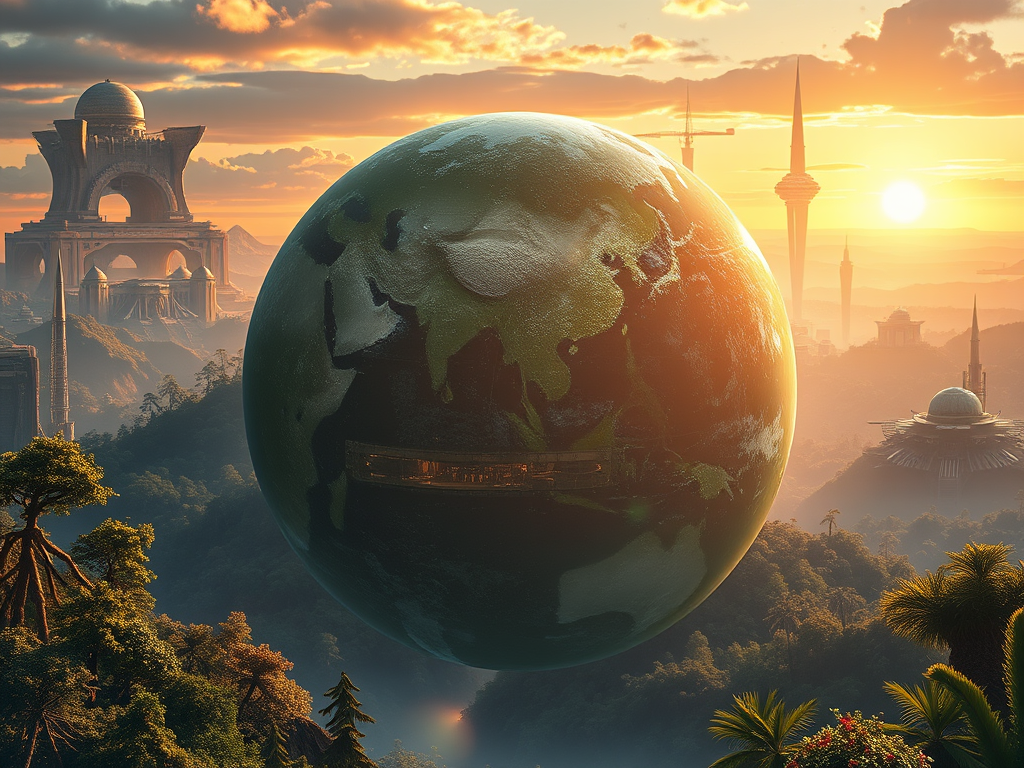
GAIA planets, NOVA planets, and hybrid planets – a definition that distinguishes, whether in practice or in theory or narrative, between types of 'life-bearing' planets according to the source to which any "civilization" found on them belongs or perceives itself as belonging.
GAIA planets – (named after Gaia, the goddess of the earth in Greek mythology) – or "Terra" or "native planets" – these are planets whose majority of inhabitants are, at least as far as is known, their original natives, in a natural-organic-evolutionary manner from ancient times, such as the Adamites on Earth who call their planet 'Mother Earth'.
NOVA planets (NOVA = 'new') are "settled planets" – whose inhabitants have been settled over the ages and originated elsewhere, or so their 'official' narratives state. Examples include 'Shpndm' (which includes 'early settlers' and 'late settlers') and Planet N, among others.
Hybrid planets – planets inhabited by both "native civilizations" (Gaia) and "settler civilizations" (Nova).
It should be noted that the inhabitants of the planet do not always know their origin, and often their self-definition depends on consciousness, and the origin to which they attribute themselves is not necessarily the factual origin. The inhabitants of one dominant civilization on a planet known to the Federation consider themselves to be the organic natives of the planet, who were previously abducted from the planet and managed to return to it. Some doubt this narrative and see them as a 'settled civilization' that has built an indigenous narrative for itself. There are, on the other hand, civilizations that believe they came from outside the planet, even though no factual proof has been found.
When it comes to an objective definition, it defines indigenous civilizations from a certain stage in their growth or the growth of their 'parent species' (such as apes as the parent species of humans) and does not address the possibility that they arrived as 'seed' or 'stardust' at an earlier time, which some attribute to all life on planets.
Massive colonization of planets is done for reasons of inability to continue to exist on the planet (ecological or cosmic disaster, hostile occupation), population density, attractiveness of the planet, as well as to maintain the "flag of the kingdom". Colonizing populations, on hybrid planets, are usually considered more intelligent or developed compared to their native populations.
 בלוג הצועד The VValker's blog
Planetas GAIA, planetas NOVA y planetas híbridos
Planetas GAIA, planetas NOVA y planetas híbridos: una definición que distingue, ya sea en la práctica, en la teoría o en la narrativa, entre tipos de planetas "portadores de vida" según la fuente a la que pertenece o se percibe a sí misma como perteneciente cualquier "civilización" que se encuentre en ellos.
Planetas GAIA – (llamados así por Gea, la diosa de la tierra en la mitología griega) – o “Terra” o “planetas nativos” – son planetas cuya mayoría de habitantes son, al menos hasta donde se sabe, sus nativos originales, de manera natural-orgánica-evolutiva desde tiempos antiguos, como los Adámico en la Tierra que llaman a su planeta “Madre Tierra”.
Los planetas NOVA (NOVA = 'nuevo') son "planetas colonizados", cuyos habitantes se han establecido a lo largo de los siglos y se originaron en otros lugares, o al menos eso afirman sus narrativas "oficiales". Algunos ejemplos incluyen "Shpndm" (que incluye "colonos tempranos" y "colonos tardíos") y el Planeta N, entre otros.
Planetas híbridos: planetas habitados tanto por “civilizaciones nativas” (Gaia) como por “civilizaciones de colonos” (Nova).
Cabe señalar que los habitantes del planeta no siempre conocen su origen, y a menudo su autodefinición depende de la conciencia, y el origen al que se atribuyen no es necesariamente el origen real. Los habitantes de una civilización dominante en un planeta conocido por la Federación se consideran a sí mismos como los nativos orgánicos del planeta, que fueron secuestrados previamente del planeta y lograron regresar a él. Algunos dudan de esta narrativa y los ven como una "civilización establecida" que ha construido una narrativa indígena para sí misma. Hay, por otro lado, civilizaciones que creen que vinieron de fuera del planeta, aunque no se haya encontrado ninguna prueba fáctica.
Cuando se trata de una definición objetiva, define a las civilizaciones indígenas a partir de una determinada etapa de su crecimiento o del crecimiento de sus "especies progenitoras" (como los simios como especie progenitora de los humanos) y no aborda la posibilidad de que llegaran como "semilla" o "polvo de estrellas" en un momento anterior, lo que algunos atribuyen a toda la vida en los planetas.
La colonización masiva de planetas se realiza por razones de incapacidad para seguir existiendo en el planeta (desastre ecológico o cósmico, ocupación hostil), densidad de población, atractivo del planeta, así como para mantener la "bandera del reino". Las poblaciones colonizadoras, en planetas híbridos, suelen considerarse más inteligentes o desarrolladas en comparación con sus poblaciones nativas.
אהבתיאהבתי